Not done
The system went live
The acceptance endpoint of traditional IT delivery — yet the business hasn't earned a single extra yuan.
Not on-site staffing. Not a consulting report. One integrated, custom solution across five dimensions — every action pointing to the same business essence: make more, spend less.
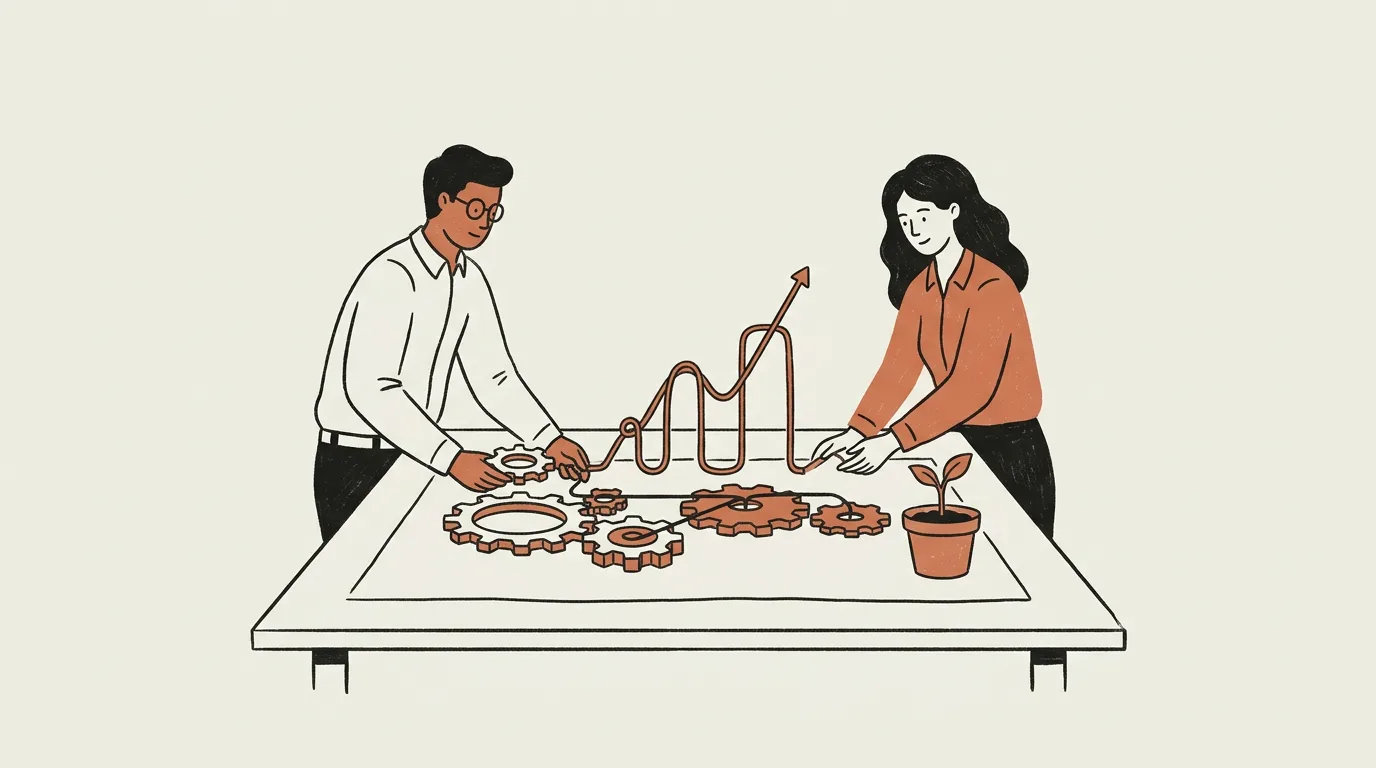
A company installs a new system, hires a consulting firm, buys AI tools — the money goes out, and at year end the profit line hasn't moved. That's not bad luck; it's the industry norm: roughly 70%1 of digital transformations fall short — and in the AI era, 95% of GenAI pilots still can't show a P&L number.
Sources: McKinsey, The State of AI 2025 (Nov 2025); MIT NANDA, The GenAI Divide: State of AI in Business 2025 (Aug 2025)
Two datasets, five years apart, pointing to the same disease: acceptance stopped at "launched" and never reached "working". So we anchor acceptance to exactly one number — a measurable, positive change in net profit:
1.BCG, Flipping the Odds of Digital Transformation Success (2020): 70% of digital transformations fall short of their objectives; McKinsey's long-run tracking points the same way (success rate ~30%). Per the same MIT study: partner-led projects succeed at roughly twice the rate of purely in-house builds. ↩
A Forward Deployed Engineer doesn't sit at headquarters waiting for a requirements document — they embed inside the client's operation, build custom delivery around real needs, and are accepted only against business value. Put plainly: the engineer moves into your shop floor, and it doesn't count until you make money. Palantir pioneered the model; over the past three years, the global AI giants have adopted it one by one:
Sources: company job postings and media coverage (Financial Times, Reuters, CNBC, 2024–2026)
Sources: LinkedIn Workforce Report 2026; Perspective AI, 2026 FDE Hiring Trends
Why the scramble? Reuters calls the FDE the hottest "hybrid role" in AI right now (Feb 2026) — because it demands three capabilities that rarely grow together, living in one team:
Source: Reuters (Feb 2026) — the FDE as the most sought-after hybrid role in AI
Silicon Valley's FDEs mostly serve software- and data-native companies. The ground truth inside Chinese real-economy businesses is messier: growth needs strategy worked out first, the critical resources live along the industrial chain, and capital is an unavoidable amplifier — walking in with engineering skill alone doesn't solve this equation. So we upgraded the FDE into an AI-native version built for the real economy — AIFDE, one integrated custom solution across five dimensions.
Not six parallel products — one complete growth chain.
Every yuan saved converts directly into net profit — and these scenarios carry a property the revenue side doesn't: they get better with use.
About these numbers: industry benchmarks come from public cases and industry research — they are not promises to future clients, nor actual data from clients we serve. Real project acceptance data prevails.
Large enterprises and SMEs face different core contradictions, so deployment must differ — but both draw on the same capability Factory underneath. How custom service scales is a story of its own — we unpack it on the Method page.
To the client, there is always exactly one interface: one contract, one team, one owner accountable for net profit — that never changes. The variation happens on the capacity side: the Factory doesn't scale by endlessly growing its own headcount. Like calling a Skill, it draws per project on a rigorously screened technical execution network.
The bar for entering this network is not low. Every technical partner must meet four conditions at once:
Being clear about what we won't do matters as much as what we will — this is service discipline, not posturing.
The full reasoning lives in our Founding Paper — four reading depths, from far to near, as deep as you care to go.
Ready to talk? Write to us: hello@deepconnect.com