Method · Factory

Custom delivery at factory cost.
Not a paradox — a method.

Think of a car factory: every car is "custom", yet none is designed from scratch — shared parts library, custom assembly. Our Factory works the same way. There is no secret recipe here; we're happy to explain it to anyone.
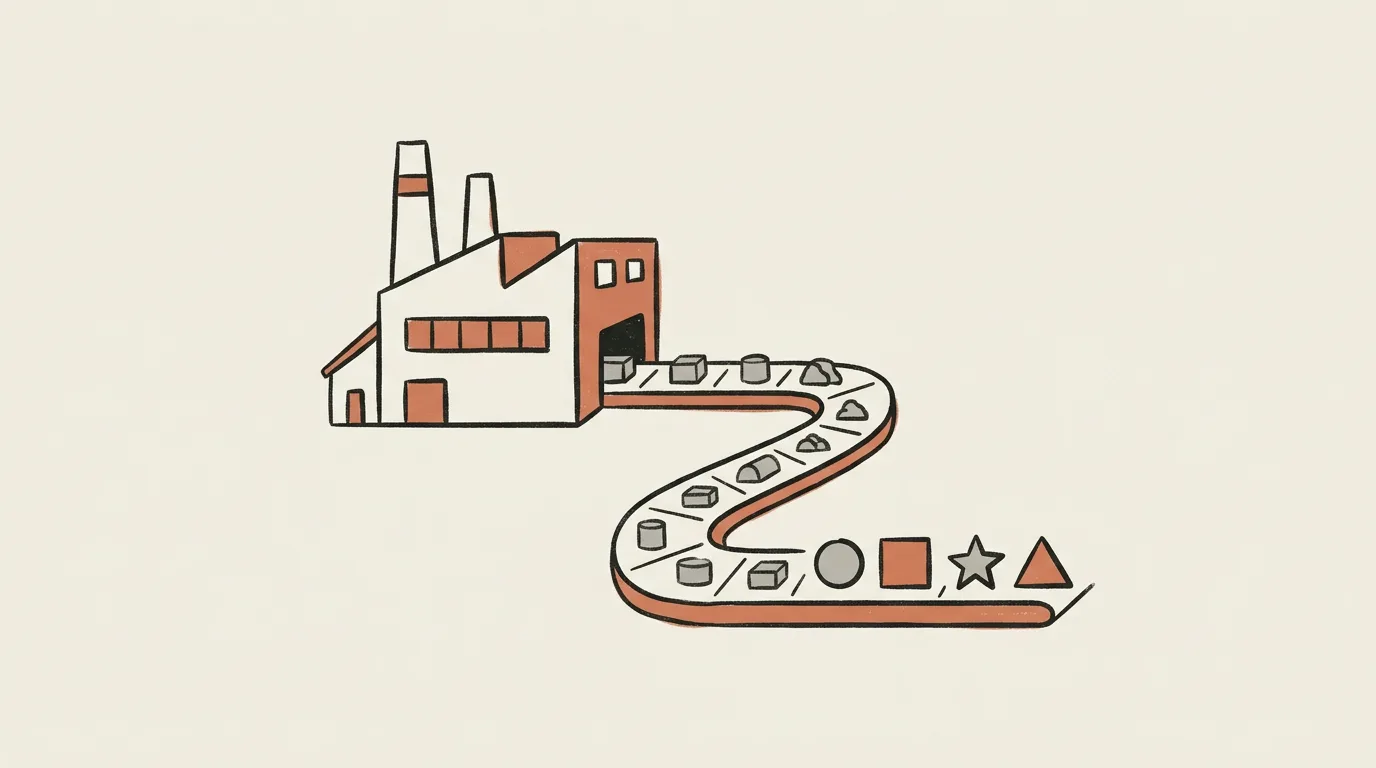
Standardized materials, custom assembly: a conveyor producing differently shaped custom objects
One conveyor, custom objects of every shape
The Analogy, Proven

This analogy isn't rhetoric —
the auto industry already proved it once.

Can "standardized materials + custom assembly" really deliver custom output at factory cost? The industrial track record of modular platforms in the physical world has already answered that question:

Toyota · TNGA
Engineering hours down 20%+
Parts commonality targeted at 70–80% — one shared parts library supporting custom output from the Corolla to the Lexus.
Renault-Nissan · CMF
Development costs down 30–40%
Modules shared across brands and models — custom delivery at platform cost, cashed in at alliance scale.
Volkswagen · MQB
Dozens of models · 100M+ units
The industry paradigm of modular platforms — one architecture supporting the largest custom production run in automotive history.

Sources: Toyota, Renault-Nissan Alliance and Volkswagen public materials and industry analysis. Our Factory is the same logic, replicated in the digital world — so the next question first: what are its "parts"?

The Raw Material

Skill: a replicable unit of business capability

A Skill is the smallest closed loop that solves one business problem. In the industry, a Skill means a function of some Agent — a purely technical view; in our definition, the human is part of the Skill. A complete loop is made of four parts:

Part one
The problem it solves
This is the entry bar: if a Skill can't state the problem it solves, it doesn't enter the library. Skills are classified by business problem, not by technology.
Part two
The human part
Judge, decide, review, backstop. In real business no action is ever pure AI — these steps always belong to a person.
Part three
The AI part
Repetitive execution, rule-based processing, data gathering and cleanup. On one condition: the process is proven in real business — an unproven process gives AI no way to produce stable results.
Part four
The collaboration
When does the AI hand off to a human, and when does the human's result feed back to the AI. Leave this boundary undrawn, and you get automation out of control.
Smallest loop that solves one problem ① The problem the entry bar — no problem, no entry ② The human part judge, decide, review, backstop ③ The AI part repetition, rules, data work ④ The collaboration when to hand off, when to feed back Only with all four parts in place is a Skill truly replicable
The four parts of a Skill: starting from the business problem, human and AI each in place, interlocking into one smallest closed loop

With all four parts in place, the loop works like a Lego brick: small-grained, composable, reusable, tied to no particular employee — capability becomes an organizational asset that no longer walks out the door with an employee.

A concrete example: in the TAETEA project, "co-branded product feasibility simulation" is one Skill — the problem it solves is "is this collaboration worth doing"; the AI runs the data and produces the simulation; the human makes the final call; the boundary is that AI delivers the full analysis and the human only signs off at key points. When the next brand wanting a co-branded launch walks in, this loop is called directly — no starting from zero.
Compounding Mechanisms

The self-reinforcing loop and the tournament

Two deep mechanisms drive the Factory — together they determine the long-term quality of the Skill Library.

Mechanism 1
The loop: withdraw and deposit at once
Every engagement does two things: withdraw — reuse existing Skills, adapted for delivery; deposit — archive new Skills, iterate old ones. More clients, richer library; richer library, lower marginal cost.
Costs fall over time while capability rises — a pure compounding structure.
Mechanism 2
The tournament: compare all, keep the best
Built the same Skill for the same scenario across several clients? All versions are lined up and compared — the weak are retired, the strong retained, and the best practices from different sources merge.
The Skill Library isn't a passive archive — it's a living asset that actively evolves.
Serve Clients every custom delivery Materials Library Skill Library · always growing Withdraw: reuse existing Skills, adapt, deliver Deposit: archive new Skills · iterate existing ones both happen in the same engagement Costs fall over time · capability rises — a pure compounding structure
The self-reinforcing loop: withdrawing and depositing happen in the same engagement
Strategic Assets

The triple-asset flywheel

The longer the loop and the tournament run, the thicker the sediment they leave — the Skill Library, the data assets, the case library. Not three parallel blocks, but interlocking gears of one flywheel.

The waterwheel keeps turning: cases yield Skills, Skills deposit data, data feeds back into cases — the longer it runs, the greater the momentum
Spins faster triple compounding Case Library what we've done Skill Library what we can do Data Assets what we know extract new Skills usage deposits data trains Skills · reveals scenarios
The triple-asset flywheel: cases yield Skills, Skills deposit data, data feeds back into cases
Capability
The Skill Library
Answers "what we can do". Capacity isn't team size (linear, capped) — it's Skill inventory (compounding, uncapped).
Information
Data Assets
Answers "what we know". Deposited only through real business — unobtainable from papers, and no single hire can carry it away.
Proof
The Case Library
Answers "what we've done". Every case fully deconstructed — we pursue depth, not headline volume.
Our confidence in the word "Factory" doesn't come from today's scale — it comes from the whole structure being designed for compounding from Day 1. The longer we run, the deeper the moat. That is also what backs the opening promise to "explain it to anyone": the method can be copied; the time cannot.
Who Owns the Assets

The value inside the flywheel doesn't belong to us alone.

The faster the triple assets spin, the more two questions matter: where do these assets live? And when they appreciate — who shares in it?

Where they live
A dedicated Skill IP entity
The entire SOP and Skill Library are held by a dedicated IP entity — it runs no business of its own and does exactly one thing: give the factory's compounding assets a stable container, unmoved by the rise or fall of any single project or client.
Who shares
Co-building clients earn long-term royalties
Early clients who build Skills with us receive ongoing royalties whenever those Skills are reused elsewhere — every time a capability grown on your shop floor runs in someone else's business, a share of it is yours.
The client stops being a buyer — and becomes a co-builder of the IP.
The longer the flywheel spins and the earlier you joined, the more you share — not a promotion, but the natural corollary of the flywheel's structure: if the assets are grown from real business, those who provided the nourishment deserve a seat in the compounding.

How does the Factory get stronger with use?

The full reasoning lives in our Founding Paper — four reading depths, from far to near, as deep as you care to go.

Ready to talk? Write to us: hello@deepconnect.com